Sectarianism in Northern Ireland
Say NothingSectarianism in Northern Ireland was not simply a matter of religious difference: it was a lived system of political exclusion, unequal opportunity, and contested space that shaped relationships, drove families from their homes, and helped turn civil-rights protest into armed conflict. The narrative also follows the persistence of those boundaries after the fighting declined, visible in segregated schools, neighborhood symbols, and walls built to contain violence while preserving division.
Historical and Political Structure
Partition left Protestants a majority in Northern Ireland but a minority on the island as a whole, while Catholics were a majority on the island and a minority in the six counties. Each community could therefore understand itself as vulnerable, but the political balance within Northern Ireland gave Catholics less power. In a population of roughly one million Protestants and half a million Catholics, Catholics were often excluded from good jobs and housing. The devolved government at Stormont had existed for half a century without a Catholic holding executive office.
Economic exclusion reinforced political inequality. Catholics were shut out of shipbuilding and other attractive professions, and many emigrated to England, America, or Australia to find work. Although the Catholic birth rate was about twice the Protestant rate, the Catholic population remained nearly static over the three decades before the march to Derry, as emigration offset natural growth. The account thus presents discrimination not as an abstract disagreement between communities, but as a force shaping who could work, remain, and exercise power.
Boundaries in Private Life
Sectarian boundaries also governed ordinary social contact. Protestants and Catholics tended to inhabit different neighborhoods, attend different schools, work in different jobs, and frequent different pubs. In the 1950s, Jean McConville’s relationship with Arthur McConville crossed that division. Jean had entered the home of Arthur’s Catholic mother as a domestic employee; their families noticed the religious difference, and Arthur’s mother resented the relationship. Jean’s uncle, a member of the Orange Order, beat her for what he regarded as a transgression. The couple eloped to England in 1952 before returning to Belfast.
By the 1960s, public hostility increasingly entered the street and the home. Orange Order marches began outside the McConvilles’ door, while Ian Paisley urged Protestants to identify and expel Catholics living among them, naming residents and local businesses as targets. Jean and Arthur had no television, so they watched the news at a neighbor’s house as the civil-rights movement and riots gathered force. The intimate scale of the account makes clear how a political boundary could be enforced through public spectacle and personal intimidation alike.
Protest and the Turn to Violence
On 1 January 1969, student protesters gathered at Donegall Square in Belfast to begin a march of about seventy miles to Derry, demanding civil rights. They had studied the American civil-rights movement and carried placards and sang as they set out. Their march passed through unionist villages where armed local crowds blocked their route; police accompanying the students diverted them around the villages, while taunts and the pounding of a Lambeg drum summoned counterprotesters. The marchers believed peaceful protest could expose injustice and perhaps redraw the political contest as one between young and old rather than Catholics and Protestants.
That hope existed alongside the expectation of violence. On the final day, a speaker warned the hundreds of marchers that stones might be thrown and asked whether they accepted the possibility of being hurt. They answered yes. The narrative places this readiness within a belief that public confrontation might produce change, but also foreshadows how quickly a protest over discrimination could become a test of physical safety. For Dolours Price, the violence at Burntollet Bridge marked a decisive loss of faith in peaceful resistance. She joined the IRA in 1971, regarding the decision as a return to her family’s republican convictions. Her experience illustrates one route by which sectarian conflict narrowed the perceived space for nonviolent politics; it does not make armed action the only response available to those facing discrimination.
Neighborhoods, Riot, and Displacement
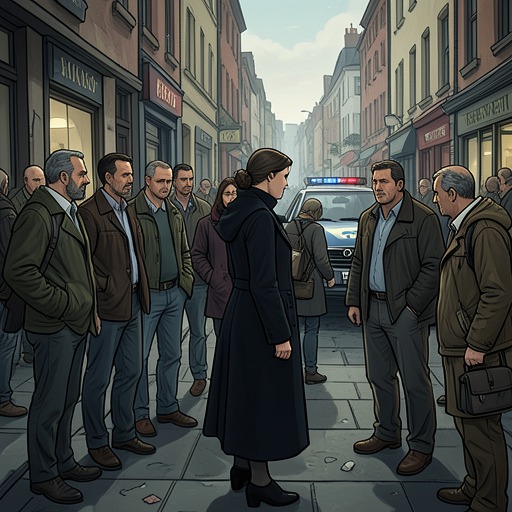
In Belfast, the Falls Road and the Shankill Road ran roughly parallel toward the city center, close but never touching. The Falls was a Catholic stronghold and the Shankill a Protestant one; narrow streets connected them, and somewhere along each, one community’s territory gave way to the other’s. During the 1969 riots, barricades made those boundaries more visible. After violence spread from Derry, Protestant gangs attacked Catholic neighborhoods, homes were burned, and Catholic residents described the Royal Ulster Constabulary and the B-Specials as failing to stop loyalist assaults. Residents erected barricades from hijacked buses and bread vans, and stones and petrol bombs became part of the street fighting.
The violence forced families to move on a large scale. Nearly two thousand families fled Belfast that summer, the overwhelming majority Catholic; over the following years, as much as a tenth of the population relocated. Some were driven out by crowds, while others received a letter giving them an hour to leave. Families crossed the city in packed cars, and thousands of Catholics queued at the railway station for southbound trains to the Republic of Ireland. The McConvilles were among those displaced: local men told Arthur to leave, and he slipped away at night to his mother’s house. Jean and the children initially remained, then packed what they could into a taxi and fled too. Barricades and boarded windows offered defense, but they also made the city’s communal borders tangible. The wreckage and broken glass came to be described as Belfast confetti.
Solidarity, Persistence, and the Peace Walls
Siege conditions could harden division while also producing local solidarity. In Andersonstown, raids and the danger of ordinary travel disrupted daily life. When authorities approached, residents used dustbin lids against paving stones to warn people in the neighborhood; children whistled from street corners at the first sign of trouble. Dolours Price later recalled that local people had changed and become republicans. Such shared resistance helped draw communities together, even as armed organizations and political identities became more prominent.
The barricades of 1969 were eventually replaced by Peace walls, and paramilitaries policed their respective enclaves. By the period described nearly two decades after the Good Friday Agreement, the city center appeared prosperous and cosmopolitan, and visitors could take tours of former flashpoints. Yet more than 90 percent of children in Northern Ireland still attended segregated primary schools. In some areas, bus stops were informally identified as Catholic or Protestant, and people walked farther to avoid harassment. Union Jacks remained common in Protestant neighborhoods; Catholic areas displayed the tricolour and sometimes Palestinian flags, signaling continued republican identification with a people regarded by many in the North as occupied.
The walls had multiplied since the height of The Troubles. They maintained a degree of calm by separating communities, but their surfaces still carried threats directed at Catholics and Protestants. In 2012, Belfast City Council’s decision to restrict the days the Union Jack flew above City Hall prompted attempts to storm the building and riots involving bricks and petrol bombs. The account’s central contrast is therefore not between a divided past and a reconciled present: reduced violence and public normality coexist with boundaries that remain active in housing, education, movement, and political symbolism.